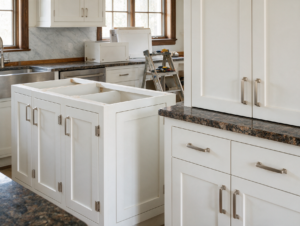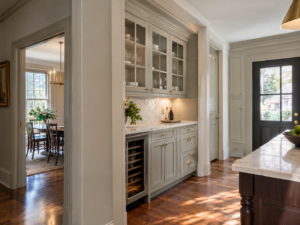
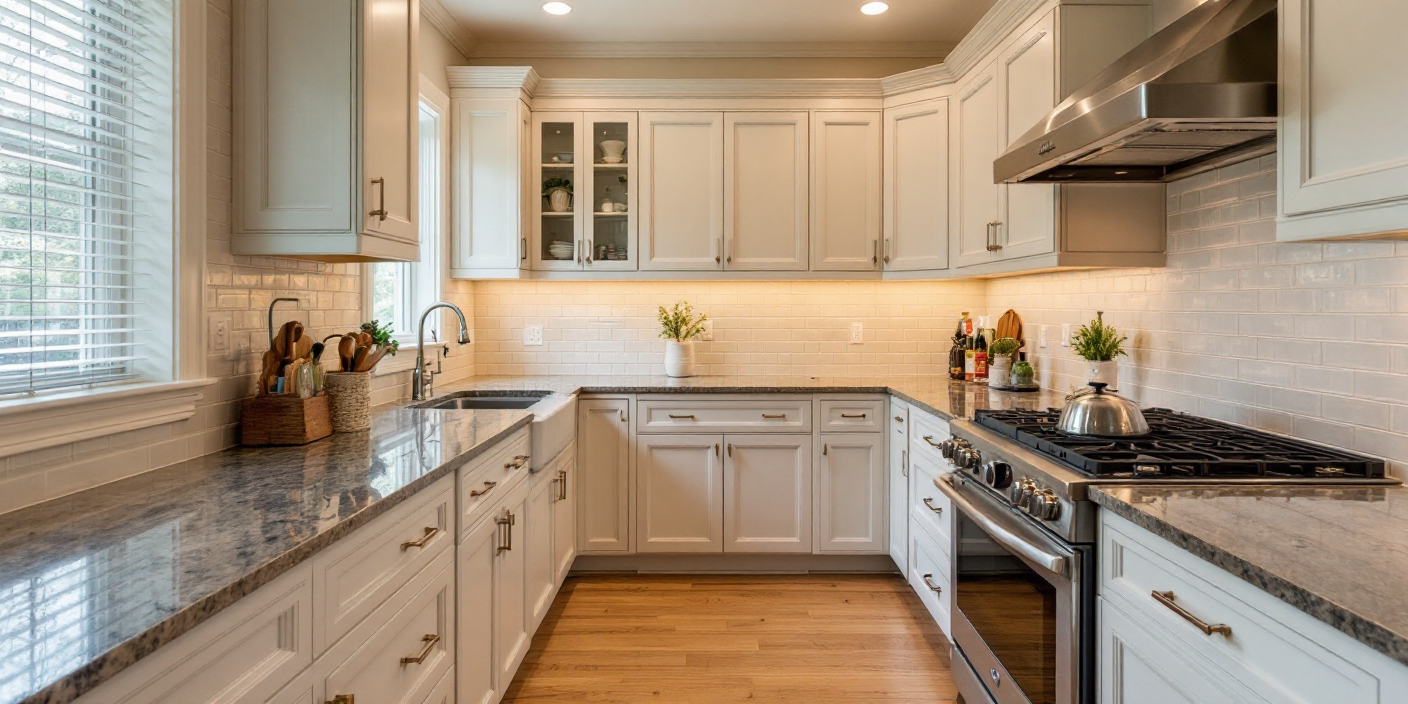
Selecting cabinetry is arguably the most consequential decision in a residential kitchen renovation. For property owners across Haddonfield, Moorestown, and Voorhees, cabinetry defines the visual character, storage efficiency, and financial allocation of the entire remodeling project. When exploring showroom samples and design proposals, homeowners encounter distinct manufacturing tiers: mass-produced stock boxes, semi-custom lines, and fully custom joinery. While stock cabinetry serves well for budget-conscious utility spaces, primary kitchen renovations in South Jersey generally narrow the choice between semi-custom and custom cabinets. Understanding the structural, sizing, and functional distinctions between these two categories ensures your investment aligns with your home’s architectural requirements.
Comparing Cabinetry Manufacturing Tiers
To evaluate which cabinet category fits your project scope, it is necessary to examine how each tier is manufactured, customized, and finished:
- Stock Cabinets: Manufactured in high-volume assembly lines, stock cabinets are sold in rigid three-inch width increments (e.g., 18-inch, 21-inch, or 24-inch boxes). They feature standardized box depths, basic finish options, and standard materials. While available with short lead times, their fixed dimensions cannot be altered to accommodate irregular room measurements.
- Semi-Custom Cabinets: Semi-custom cabinetry begins with standardized factory box dimensions but allows remodeling contractors to specify dimensional modifications. Homeowners can adjust box depths, request height modifications, and select from an extensive catalog of door profiles, wood species, and factory-applied paint or stain finishes. Semi-custom lines represent a balance of versatility and production efficiency, typically requiring six to eight weeks for delivery.
- Custom Cabinets: Built entirely from raw lumber to exact millimeter specifications, custom cabinetry eliminates all dimensional restrictions. Crafted by skilled millworkers utilizing three-quarter-inch furniture-grade plywood boxes, solid hardwood face frames, and dovetailed drawer joinery, custom cabinets can be engineered to navigate any structural obstacle, unusual room angle, or soaring ceiling height, requiring eight to twelve weeks for fabrication.
Navigating Nonstandard Walls and Architectural Obstacles
In historic and established South Jersey communities, residential interiors rarely exhibit perfectly straight walls or level subfloors. Natural timber settling over decades can leave brick party walls and plaster surfaces out of plumb. Attempting to install rigid, standardized semi-custom cabinet boxes along an uneven fourteen-foot kitchen wall often results in dimensional discrepancies at room corners.
To bridge these gaps, standard installations rely on wide wooden filler strips bolted between cabinet runs and wall corners. While functional, utilizing three or four three-inch filler strips in a kitchen wastes nearly a linear foot of potential storage space.
Custom cabinetry eliminates wasted space and filler strips entirely. Master carpenters hand-scribe custom face frames and end panels to match the exact contours of uneven walls. Adhering to Architectural Woodwork Institute quality standards, custom millworkers construct angled corner pantries, build shallow storage runs around protruding brick chimney breasts, and engineer ceiling-height upper boxes that follow sloped ceiling lines, transforming structural anomalies into seamless built-in furniture.
Engineering Specialized Internal Storage Accessories
While semi-custom catalogs offer robust internal storage accessories—such as pullout trash bins and basic cutlery trays—custom joinery allows homeowners to engineer the interior of every cupboard and drawer around specific culinary workflows.
Custom storage engineering can incorporate full-extension, heavy-duty pot-and-pan drawers with dovetailed maple joinery, vertical spice pullouts directly flanking cooking ranges, tiered knife and utensil inserts, and appliance garages with retracting pocket doors that conceal mixers and coffee makers. For open-concept floor plans in Moorestown or Haddonfield, custom cabinetry also enables the precise integration of panel-ready refrigerators and dishwashers, disguising modern appliances behind matching wood door panels for an uninterrupted architectural finish.
Coordinating Field Measurements and Construction Sequencing
A critical distinction in cabinet planning is understanding that final joinery dimensions should never be ordered based solely on initial architectural drawings. Regardless of whether you choose semi-custom or fully custom lines, exact on-site field measurements must be verified after old kitchen demolition is complete, framing is repaired, and subfloors are leveled.
Cabinetry installation must coordinate logically with surrounding trades; rough-in plumbing stacks must align beneath sink base cabinets, electrical wiring for under-cabinet LED strip lighting must be routed before drywall hanging, and flooring must be installed onto a flat subfloor before cabinetry is anchored. By collaborating with a specialized team for custom cabinetry in Haddonfield NJ, you ensure that your storage joinery is engineered to fit your property perfectly. Contact Haddonfield Kitchen & Bath Remodelers today to explore wood species, finish samples, and tailored storage features as part of your comprehensive kitchen remodeling plan.
What is the difference between semi-custom and custom kitchen cabinets? Semi-custom cabinets start in standard factory sizes but allow for depth and height adjustments from an established catalog. Custom cabinets are built from scratch to exact millimeter dimensions without catalog restrictions, fitting any unique room shape or architectural feature perfectly.
Why do some kitchen cabinet installations require wide wooden filler strips? Filler strips are used when installing standardized cabinet boxes along walls that are uneven, out of plumb, or whose lengths do not divide evenly into standard three-inch cabinet increments. Custom cabinetry eliminates filler strips by scribing cabinet frames directly to the wall.
How long does it take to manufacture and deliver custom kitchen cabinets? Custom cabinetry typically requires eight to twelve weeks for fabrication from the date final on-site field measurements are recorded. Because they are built from raw lumber to exact room dimensions, production cannot begin until demolition and framing repairs are finished.
Are solid wood cabinet boxes better than plywood cabinet boxes? High-end cabinetry utilizes three-quarter-inch furniture-grade plywood for cabinet boxes and interior shelves because plywood possesses superior structural stability and resists moisture warping. Solid hardwood is best reserved for visible exterior face frames, cabinet doors, and dovetailed drawer boxes.
Can custom cabinetry be matched to a specific designer paint color? Yes. Unlike semi-custom catalogs that offer a fixed selection of factory finishes, custom cabinetry can be color-matched and finished in any precise paint shade, sheen level, or custom wood stain using durable, catalyzed conversion varnish coatings.