Two kitchen cabinet lines can look almost identical in a showroom. Same door style, same paint color, same hardware. The difference shows up years later: a sink base that swelled after a small leak, drawers that sag, or shelves that bow under dishes. Most of that comes down to how the cabinet box is built.
For homeowners in Haddonfield, Collingswood and Cherry Hill planning a kitchen remodel, this guide explains the materials used in cabinet boxes, the construction details that matter, and the questions to ask before you sign a cabinet order.
The Parts of a Cabinet
When people compare cabinets, they usually focus on doors. But a cabinet has several components, and each can be built with different materials:
•The box (case): the sides, bottom, top and back.
•The face frame: a solid wood frame on the front of framed cabinets. Frameless (European-style) cabinets do not have one.
•Doors and drawer fronts: the visible surfaces.
•Drawer boxes: the boxes that slide in and out behind the drawer fronts.
•Shelves: fixed or adjustable.
•Hardware: hinges and drawer slides.
A cabinet can have solid wood doors and a particleboard box, or plywood sides with an MDF back. Ask about each component, not just “what is it made of.”
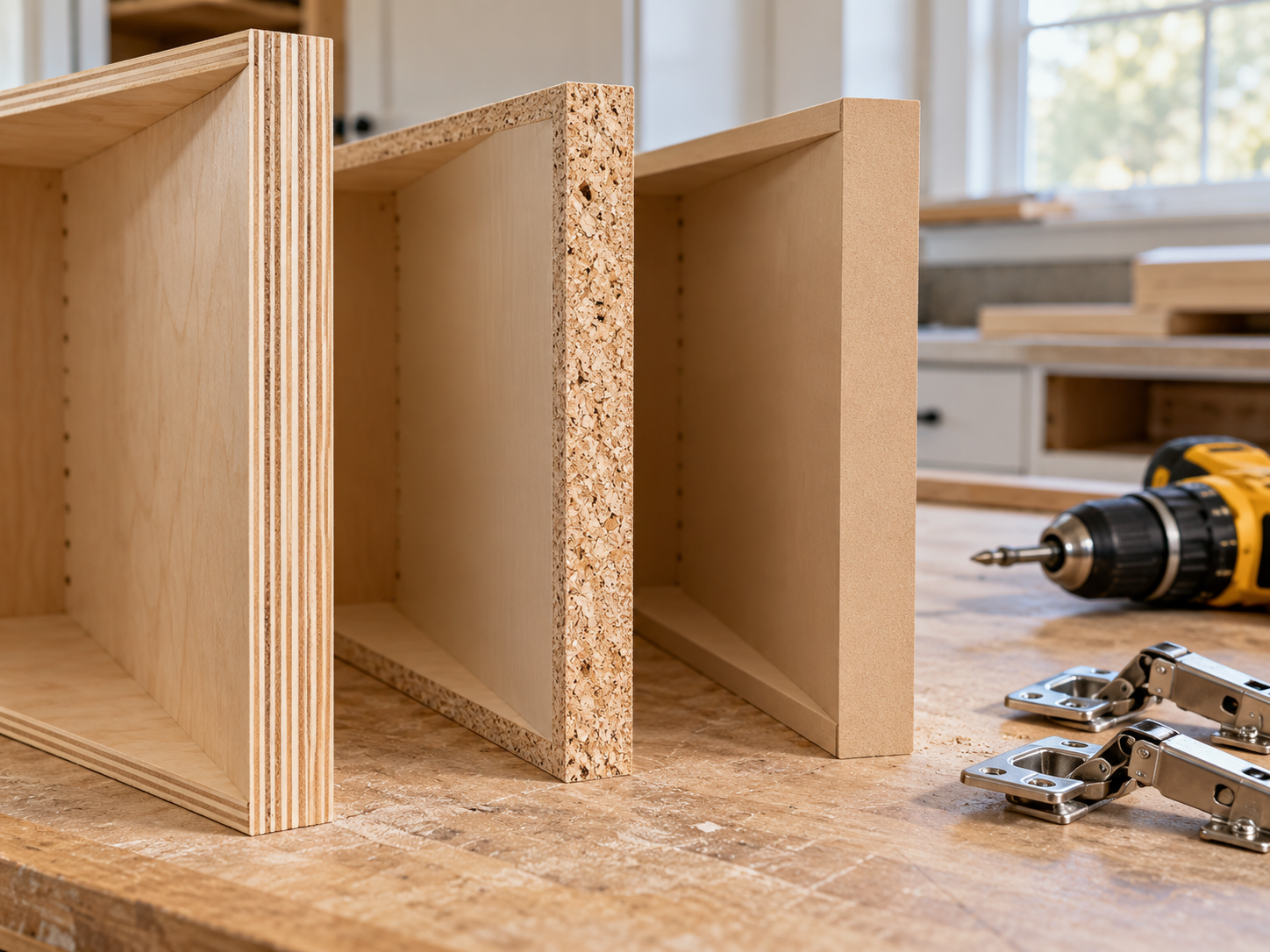
Box Materials Compared
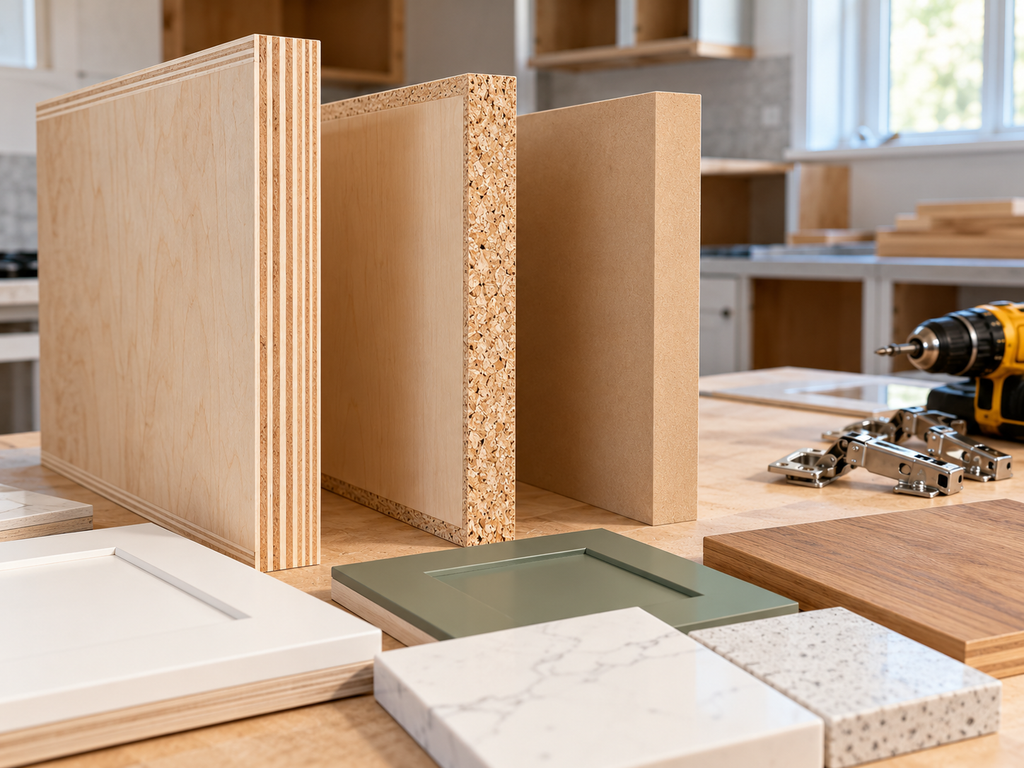
Plywood
Plywood is made from thin layers of wood veneer glued together with the grain alternating. That cross-layered construction gives it good strength for its weight and helps it hold screws.
•Strengths: good screw-holding, lighter than particleboard, and generally more tolerant of brief moisture exposure.
•Considerations: usually costs more. Quality varies with the number of plies and the veneer grade. Edges are typically covered with banding.
Particleboard
Particleboard is made from wood particles bonded with resin and pressed into panels. Most stock and many semi-custom cabinet lines use it, usually covered with a melamine or laminate surface.
•Strengths: flat, dimensionally stable in dry conditions, and economical. Higher-density boards perform considerably better than low-density boards.
•Considerations: heavier, lower screw-holding than plywood, and can swell permanently if water reaches an unsealed edge or cut.
MDF (Medium-Density Fiberboard)
MDF is made from fine wood fibers pressed with resin. It is very smooth, which makes it a common choice for painted doors and panels.
•Strengths: a smooth, stable surface that paints well, with no grain to telegraph through the finish.
•Considerations: heavy, and like particleboard it is vulnerable to swelling at exposed edges.
Which Is Best?
There is no single answer for every cabinet. Many quality lines use plywood boxes for sink bases and wall cabinets and MDF for painted doors. What matters is that the material fits the location and is well made. A dense particleboard box with sealed edges, good hardware and sound joinery can outperform a poorly built plywood box.
Construction Details That Matter More Than the Label
•Box side thickness: thicker sides resist racking and hold hinges and slides more securely. Ask the actual thickness.
•Back panel: a full-thickness back adds rigidity and gives solid material to screw into the wall. Thin backs depend on separate hanging rails.
•Joinery: dadoes, dowels and glue blocks are generally sturdier than staples alone.
•Shelf thickness and span: wide shelves in thin material can bow under heavy dishes. Ask about shelf thickness for wide cabinets.
•Edge banding: all exposed edges, especially on shelves and the cabinet bottom, should be banded or sealed.
•Drawer boxes: solid wood or plywood boxes with dovetail joints, or metal drawer systems, generally hold up better than stapled particleboard boxes.
•Drawer slides: full-extension slides let you reach the back. Check the slide’s load rating for pot drawers.
•Hinges: adjustable concealed hinges let the installer align doors after installation.
The Sink Base Deserves Special Attention
The sink base is the cabinet most likely to see water from a dripping trap, a failed supply line or a dishwasher leak. Ways to protect it:
•Choose plywood or a moisture-resistant panel for the sink base, even if the rest of the kitchen uses particleboard.
•Ask whether a sink base mat or liner is available.
•Have the plumber use quality supply lines and shutoff valves and check every connection before the cabinet is loaded.
•Seal cutouts made on-site for plumbing.
Formaldehyde and Composite Wood
Particleboard, MDF and hardwood plywood are made with resins, and some resins emit formaldehyde. The U.S. Environmental Protection Agency regulates formaldehyde emissions from these products. According to the EPA, the rule covers hardwood plywood, medium-density fiberboard and particleboard, as well as household and other finished goods containing them, and since March 22, 2019 those composite wood products must be labeled as TSCA Title VI compliant.
When you compare cabinet lines, it is reasonable to ask the manufacturer to confirm their composite panels comply with the federal standard. Some manufacturers also offer lower-emitting or no-added-formaldehyde options.
Framed vs. Frameless Cabinets
•Framed cabinets have a face frame around the opening. They are traditional, rigid, and suit many older South Jersey homes, especially with inset doors.
•Frameless cabinets have no face frame. Doors mount directly to the box sides, giving slightly more interior space and wider drawer openings.
Either style can be built well or poorly; the box material and joinery still matter.
Installation Is Part of Quality
Even well-built cabinets fail early if they are installed badly. Many homes in Haddonfield and Collingswood have floors that are out of level and walls that are not plumb. A good installation:
•Levels base cabinets with shims, not by forcing them to the floor.
•Fastens wall cabinets into studs or blocking.
•Scribes fillers and end panels to irregular walls rather than leaving gaps.
•Leaves sink bases and appliance openings accurately sized for the equipment.
Questions to Ask Before You Order
1. What material are the box sides, bottom, back and shelves made of, and how thick are they?
2. Is the sink base built differently from the other cabinets?
3. How are the drawer boxes built, and what slides are used?
4. Are the hinges adjustable, and do they have soft-close?
5. Are all exposed edges banded or sealed?
6. Can the manufacturer confirm composite panels meet the federal formaldehyde standard?
7. What does the manufacturer’s warranty cover, and what voids it?
Frequently Asked Questions
Is plywood always better than particleboard for cabinets?
Not always. Plywood holds screws better and generally tolerates brief moisture better, but a dense, well-sealed particleboard box with good hardware can perform well in dry locations. Plywood is most valuable at the sink base.
Why are painted cabinet doors often MDF?
MDF has a smooth, stable surface without grain, so paint finishes look uniform and wide panels are less prone to seasonal movement than solid wood.
Can I mix materials in one kitchen?
Yes. Many homeowners choose plywood for the sink base and wall cabinets and a different material elsewhere to manage cost.
Choose the Box, Not Just the Door
The door style is what you see, but the box determines how the cabinets handle daily use and the occasional leak. Asking the right questions before ordering helps you compare lines fairly.
Haddonfield Kitchen & Bath Remodelers LLC installs kitchen cabinetry in South Jersey homes and can walk you through construction options before you order. Learn about our cabinet installation services.